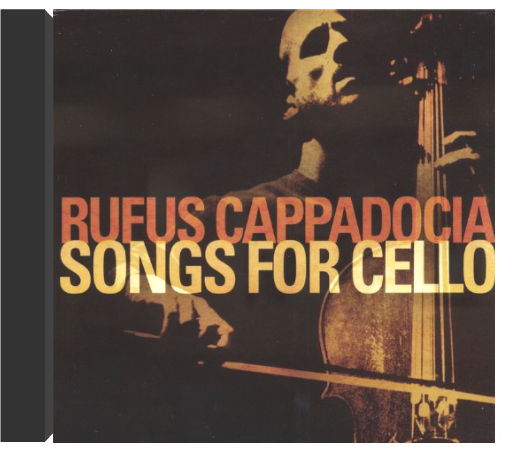
 Songs for CelloRufus Cappadocia Songs for CelloRufus Cappadocia  Rufus Cappadocia is both a musical maverick to the bone and one of the leading voices of cutting edge cello today. His jaw dropping technique and musicianship inspire awe in even the most discerning critics, who have characterized his playing as powerful...exploring territory that is positively otherworldly. He has toured throughout the Americas and Europe with both fringe and famous groups that are legion amongst those who search for peerless musicianship, and is celebrated for his unique collaborations with artists from across the globe — from the Balkans to the Caribbean, from West Africa to North America. Rufus has toured as a founding member of numerous groups such as Urban Tap and The Paradox Trio; has co-produced a CD with Barney Mcall (piano Gary Bartz) and Badal Roy (tabla Miles Davis); and has just finished recording and co-producing a new project, Vodou Drums of Haiti, with Bonga Jean-Baptiste as well as releasing a CD with Bethany Yarrow "900 Miles" ( Hyena records). Songs for Cello is Cappadocia's latest album of Unaccompanied Solo Cello, drawing on the rich tapestry of influences from his musical world. New York Newsday hailed a Town Hall performance by Rufus (at the Black Rock Coalition s Tribute to Hendrix Concert) as the evening s most mesmerizing moment, and Rufus has made a career of going where few cellists have gone before, appearing on CD s with Ross Daly, Kif with David Fiuczynski, DJ Cheb i Sabbah, Esma, The Paradox Trio, Odetta, Michael Blake, and Tamalalou, among others. Rufus has also performed with Kasse Mady, Aretha Franklin, The Black Rock Coalition, Theodossi Spassoff, Cheick Tidiane Seck, Michael Hill, Vernon Reid, and many more. After years of experimentation and creative revision, Rufus plays a self-designed five-string electric cello that extends the bass range of the cello and through amplification expands its tonal possibilities, creating new sounds by what was once known only as a classical music instrument.  The Pied Piper of JazzRufus Harley The Pied Piper of JazzRufus Harley Rufus Harley is unquestionably the greatest bagpipe player in jazz history. Given the competition, that may seem a rather dubious distinction, but one listen to The Pied Piper of Jazz will convince all but the most skeptical. Culled from a number of Atlantic recordings (circa 1966-67), these tunes prove that Harley's instrument is far more than a novelty. Combining a droning nasal sound, reminiscent of John Coltrane's "My Favorite Things" soprano sax style, Harley coaxes the bagpipes to swing soulfully on "Feeling Good" and "Bagpipe Blues." His more conventional tenor sax is featured on "Pipin' the Blues" (along with guest Sonny Stitt), and his Roland Kirk-influenced flute sound is displayed on "More." In short, the idiosyncratic elements of Harley's bagpipes sound downright hip when he's on sax and flute, two obviously more pivotal jazz horns. What's ultimately fresh here is that mix of soulful, standard jazz methodology and something almost entirely new, even decades after Harley's pipes were caught on tape. —Wally Shoup 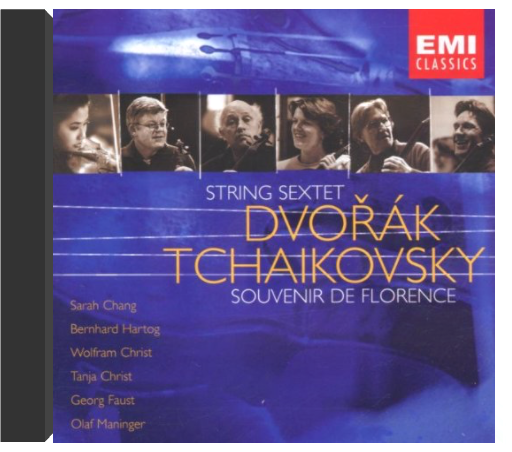 Dvorak: String Sextet / Tchaikovsky: Souvenir de FlorenceSarah Chang, Bernhard Hartog, Wolfram Christ, Tanja Christ, Georg Faust, Olaf Maninger Dvorak: String Sextet / Tchaikovsky: Souvenir de FlorenceSarah Chang, Bernhard Hartog, Wolfram Christ, Tanja Christ, Georg Faust, Olaf Maninger  Part: LitanySaulius Sondeckis, Lithuanian Chamber Orchestra Part: LitanySaulius Sondeckis, Lithuanian Chamber Orchestra With Litany, Estonian composer Arvo Pärt created one of his stirring works: a nearly 23-minute long composition for orchestra and vocal ensemble based upon the 24 prayers of St. John Chrysostom (one for each hour of the day). Commissioned for the 25th Oregon Bach Festival, the composition is both memorable and timeless. It finds influences in everything from chant to the repetition of modern minimalism. Play it loudly and the striking vocals of the Hilliard Ensemble simply soar against the strings of Tallinn Chamber Orchestra. The orchestral Trisagion harkens towards Litany's mood swings and impact, but—sans voice—lacks the mysticism. One of Part's best, and as sacred as modern compositions come. —Jason Verlinde 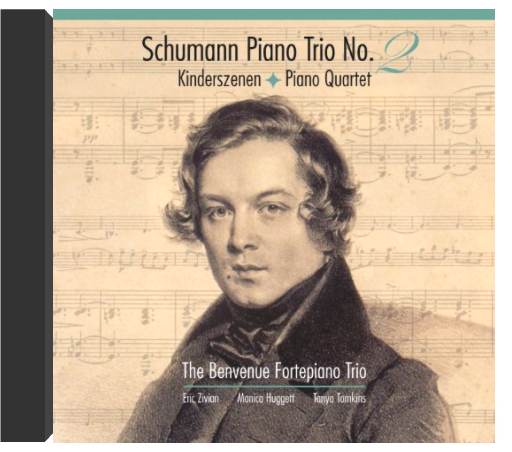 Piano Trio No. 2 / Kinderszenen / Piano QuartetSchumann, Benvenue Fortepiano Trio Piano Trio No. 2 / Kinderszenen / Piano QuartetSchumann, Benvenue Fortepiano Trio The Benvenue Fortepiano Trio s acclaimed accounts of Schumann s First and Third Piano Trios opened the ears of chamber music devotees with the crystalline textures of its period instruments and the drawing-room intimacy of its interpretations. Anchored by the enterprising violinist Monica Huggett, who has produced numerous chart-topping recordings and a Grammy® nomination for Avie Records, the Trio completes Schumann s canon for the genre, complimenting the Second Trio with the Piano Quartet and casting the spotlight on Eric Zivian and his mellifluous 1841 instrument with his rendition of Schumann s beloved Kinderszenen. |
 Made with Delicious Library